


Shop the article


A Massive Camera In The Middle of Stirling: What Could Go Wrong?
Have you ever seen a Camera Obscura in real life? This is the device that first allowed people (in ~5th Century BC China) to project a vision of real life directly onto a flat surface. Over the centuries it was used for scientific research and by painters who used the projection to create landscape sketches. Eventually science progressed to the point where light-sensitive chemicals could be painted on the paper directly - and the field of photography was born.
These days they remain a fantastic quick way to make you feel like you're 'inside' a camera, and spark interest in folks who might otherwise walk straight past a photography exhibition! And with this in mind Al Dawes decided to set up his Camera Obscura in the middle of Stirling on the weekend of the Big Film PhotoWalk to advertise the upcoming Stirling photography festival... Let's find out how he got on!
Al - thank you so much for sharing your experiences with the rest of the analogue community! So how long have you been shooting film and how did you get started in the hobby?
I grew up in a family where cameras and photo albums were always present. My grandfather was a traditional chemist with a keen interest in photography, which passed on to my mother and then to me and my siblings - we all had cameras from an early age, in the late 70s early 80s. I aways found photos enchanting, and marvelled at the aesthetic - that combination of cheap point and shoot cameras with the popular snap and shoot films of that era.

Al with one of the day's portraits
But it was going to art college in the late 80s where the magic of analogue photography hit me. I specialised in photography and had an amazing lecturer that I'm still in touch with. He just fed me so many ideas and fuelled my interests, curiosities and energy. I went on to study fine art photography at Derby in the 90s but despite the likes of John Blakemore and others trying to teach me, that level of education just wasn't for me at that time in my life and I dropped out of University.
I went on to study and work in ecology and conservation and largely parked my creative photography for 20 years. I've had a love of pinhole since I was introduced to it at art college so I kept tinkering around with that as and when I had time and a bit of spare cash. It was lockdown and a few life events that made me pick it all up again. Having the time, and realising the camera capabilities of mobile phones reignited my passion for photography. Naturally that just led me back to where I'm happiest, shooting on film and being in the darkroom. Mmmm.... the smell of the darkroom!
What’s your favourite camera to shoot with - and what kind of film do you usually use?
I don't have a head for technology so the simpler the better for me, hence the love of pinhole. I worked in a camera shop for a while so I understand and can use all levels of cameras but it's not what it's about for me. I believe you can make amazing images without the need for technology. To be honest, the more complicated the cameras are, like modern digital SLR and mirrorless the more of a turn off it becomes. I find using them just becomes a wrestle between fathoming the camera settings and creativity. [Ed: this is a very common feeling from analogue shooters!]
Back in the day, my workhorse was a Nikon FM2, which I adored until someone dropped it in the sea by accident! Looking back it was probably the simplicity of it that appealed so much.

Iconic!
I also had a beautiful Rollei 35S which went everywhere with me for years but I sold it when I needed money to feed my family instead!
Now I'm mostly shooting large format 4x5 film in pinhole cameras - usually cameras that I've made myself. I think I've found a sweet spot where shooting this size negative negates a real need to enlarge them so I don't need to fit an enlarger in my wee darkroom tent in my spare room! Depending on the focal length of the pinhole camera I'm using, I'll use FP4 or HP5 to utilise their film speeds and keep exposure times to a reasonable length. I'm not fanatical about grain and contrast - it's more about the image - but I love the results of Ilford films and they've never let me down. I tried some cheap 4x5 films but it was a false economy: they weren't cut square and most were missing the indents which made handling and loading them such a nightmare.
What made you think that setting up a Camera Obscura in the middle of Stirling would be a good idea?! I assume this isn’t the first time you’ve built it somewhere busy!
The technology of cameras is just superfluous distraction. In essence, a camera is just a box with a hole in it. Showing and demonstrating this to most people blows their minds. We've grown up with adverts and experts convincing us we all need the fanciest, most complicated cameras. They become objects that are so expensive they are too precious to play with. But creativity is inseparable from play. Stripping away needless technology and keeping it simple re-invites people to embrace that childish curiosity that develops and fuels creativity. We can make images in a bedroom by drawing the curtains and leaving a little gap and then watching the cars and the people on the street walk by, upside down on your ceiling. What's not to marvel about that?

Refining this process slightly, using a gazebo and a lens from Poundland reading glasses just enhances the experience. Why wouldn't you then want to make giant photographs using the obscura, haha? Take pictures whilst people are actually inside the camera watching the exposure and development? Definitely! What better way to demonstrate photography and engage people? It's simple, basic photography but the scale of it and the magic of the chemistry enthrals people and will hopefully inspire them.
The obscura always pulls people in but, yes, Stirling High Street is definitely the busiest place I've set it up so far and it's definitely the busiest I've been working it, which is great.
What were the biggest logistical challenges you faced?
Actually getting it to work! I knew I wanted to create images that made an impact so it was a case of sourcing materials big enough and finding a lens that would create an image circle big enough.
It seemed natural to approach Analogue Wonderland for help obtaining materials for the project given the history of their street photography photo walks and sponsorship of Stirling Photography Festival. [Ed: 😘]

David Mitchell is a friend of mine who collects and sells old cameras and lenses (@analoguephotographystilring) and I've been drooling over an enormous old World War 2 era lens he has in his collection called Big Bertha! It was made for a large format camera, fitted underneath Spitfire aeroplanes used for map making and surveillance. Now I finally had a reason to play with it! And these are likely the first photographs it's taken in over 80 years.
We ended up with approximately life size projection so the portraits look amazing.
Woah!! The first photos in 80 years - that's awesome. Were there any particular hairy moments in the set-up?
I worked with a friend, Gregg McNeill of Darkbox Images (@gcminephoto) who is incredibly knowledgeable about historical processes and cameras. We managed to set up the obscura in his studio - with only a few inches to spare! This way, we could control the light whilst we trialled focal lengths and light-tightness of the obscura. It's always a special moment when you get things to work and it didn't actually take us long to get a setup that produced an image that was life size or maybe even slightly bigger.

The light tightness was fixed with a lot of duct tape! The tiny holes from the stitching and zips are insignificant so don't fog the paper. Stopping the bottom of the gazebo from flapping in the wind when its sat on the paving is an issue but it's just a case of weighing it all down.
Was there any part of the project you were particularly excited about?
For me, it's largely about people's reactions. I love seeing the "wow" and "penny drop" moments when people realise how light behaves and how cameras work.
Producing portraits that come with a story for people is special. I'm really looking forward to exhibiting the portraits later this year.
What is/are your favourite photo(s) from the project and why?
Oh that's not fair to ask - it's far too tough to choose! But if I have to, perhaps it would be the first portrait we made after a few test shots. My son called in to the studio with his girlfriend just as we were ready to try a portrait so we got her to pose. We were just using 5x7 inch sheets of photo paper for tests, to reduce costs and wastage. When we came out the obscura holding the wet negatives we were all so excited and the phones came out to invert them to positives. there was that wow moment for her and my son but also for Gregg and me.

I like the digital positive image made by our phones in that moment: the montage effect, the black dots where the magnets held the paper during exposure and the details of the developer dish etc around the portrait. The rawness, the spontaneity and the story of the image captures the excitement for me.

But all the portraits we then made on the street are fabulous. The lens has such a shallow depth of field it creates such beautiful portraits. The bokeh is incredible, unlike anything I've ever worked with. The sensitivities of the black and white paper alters hair colours and skin complexions, producing an ethereal quality to the portraits. They're just sublime.

What is your most unexpected photo from the project and why?
I love how the street obscura attracted the attention of people who perhaps wouldn't otherwise put themselves forward for having their portrait taken. So, I think that's the "unexpected" aspect I like about it. It sounds cheesy but everybody is beautiful and we all have such interesting faces. Our eyes, freckles, lines and dimples are all features that tell our stories. And we all deserve to be seen and have our stories heard.

Is there anything you’d do differently - from a photography point of view - if you were to set up the camera in a new city?
Not that I can think of. I try not plan and overthink too much. I prefer being led by instincts and seeing how and where things develop naturally. I think different cities and locations will simply create different projects so that's an exciting prospect.
What would you say to anyone who is curious about experimenting with Camera Obscuras?
Just do it! You don't need fancy equipment to get started.
- Choose a window with an interesting view and ideally of something that will move like traffic or people but a windy day works well if trees are blowing and clouds passing.
- Lightly spray water on the glass and kitchen foil will stick to the window to blackout the light (don't leave it on too long or in direct sunlight because if it dries out it needs scraping off. But a few hours will be fine).
- Scratch a small hole in the foil - depends how sunny it is but a hole about the size of a 10 pence piece is a good start - and an image will project in to the room, upside down and back to front. Plain and light walls will show the image better.
- Give your eyes time to adjust to dark.
- Use your camera phone to take a picture of your room as they have incredible capabilities of shooting in low light these days.
If you catch the bug, you can experiment with cheap plastic lenses from reading glasses for example. Lenses allow you to have a bigger hole so make lighter images that are easier for our eyes to see. And a bowler hat to act as a lens cap 😉

What is your next planned adventure, and which camera/film will you be taking to capture it?
I'm currently working on a study of the River Forth. Environmental portraits of people along the river as well as some landscapes. I'm using a digital camera for the portraits and my pinhole cameras for the landscapes.
I acquired an ultra large format 12x20 inch camera a few years ago and I haven't really had opportunity or reason (or finances for that matter!), to play around with it but I'm interested in doing some pinhole photos with it on paper negatives and using riverside plants and the river water to develop the negatives and prints as a way of really connecting the work with the subject.
Tell us about the Stirling Photography Festival - when is it on and what does it involve?
The Stirling Photography Festival is Scotland’s only annual photo festival, which began in 2017. It pops up each year in August and September. We're just about to launch this year's programme and we have so many great exhibitions, talks and workshops lined up.
Generally, exhibitions and events last for about a month. Each year we work with partners like Street Level Photography in Glasgow, the Tollbooth and Macrobert Arts Centre to bring headline exhibitions to Stirling. But we’re not just about established photographers because a central aim is to make photography inclusive to everybody by making all events free to build a community that fosters local photographers at early stage career, studying at college or keen amateurs.
We also have a great track record of facilitating collaborations between photographers and other artists, not just other photographers but with poets and filmmakers for example, providing opportunities for photographers to develop their skills in lots of ways.
The festival is run completely by a group of passionate volunteers, if you’re local and interested in being a part of it, just get in touch. Keep an eye on our website and socials for details of what’s on.
Where can people go to see more of your photography?
Haha, I'm rubbish at promoting my work! So often it's the creative process that excites me more than the finished photograph. I don't have a website but I do have various Instagram accounts for different projects and ideas but I'm terrible at posting regularly on them. Most of my output is digital photography because of the ease and immediacy of it. I love all aspects of photography though and think cameraphones are an extremely powerful way of democratising photography.
Traditionally, photography was the pursuit of only those that could afford it, and to a large extent it still is, especially the increasing interest in analogue processes. But, virtually everybody has a mobile phone now and they all have amazing cameras on them. The potential nowadays for everybody to be creative with photography is unparalleled in history.
I like challenging the idea that photography needs expensive specialist equipment to be considered art. My biggest project in the past few years, called “…the thing with feathers”, is all done with my cameraphone, taking photos of flying birds with clouds and I think I manage to create some really beautiful images.

I also enjoy blending digital and analogue processes. Situations like the street obscura are a brilliant case in point. We only made negatives on the day to reduce development times and maximise the number of portraits we could take, but everybody wants to see the positive finished pictures straightaway.
So, we used our phones to invert the negatives and show people the portraits. It is a great way of engaging people with photography: showing them the basic physics of light, a traditional photography process and finishing the demonstration off and relating it to modern life by using a phone camera.

So, I don't have a solely analogue account but my film photography and the obscura work would be on my @w.t.f.stop Instagram account.
I'm obviously involved with Stirling Photography Festival and we're in the process of becoming a SCIO in collaboration with David and Gregg’s venture, Wolfcraig Studio (@wolfcraigstirling) and Darkroom in Stirling so I'll continue to be busy working with these projects: curating the annual programme, creating new work and hosting workshops so folks can keep an eye on those websites and socials to see what I'm up to.
All photos supplied by David Mitchell and Gregor Boyd
Ready to dive in?
Keep Reading
View all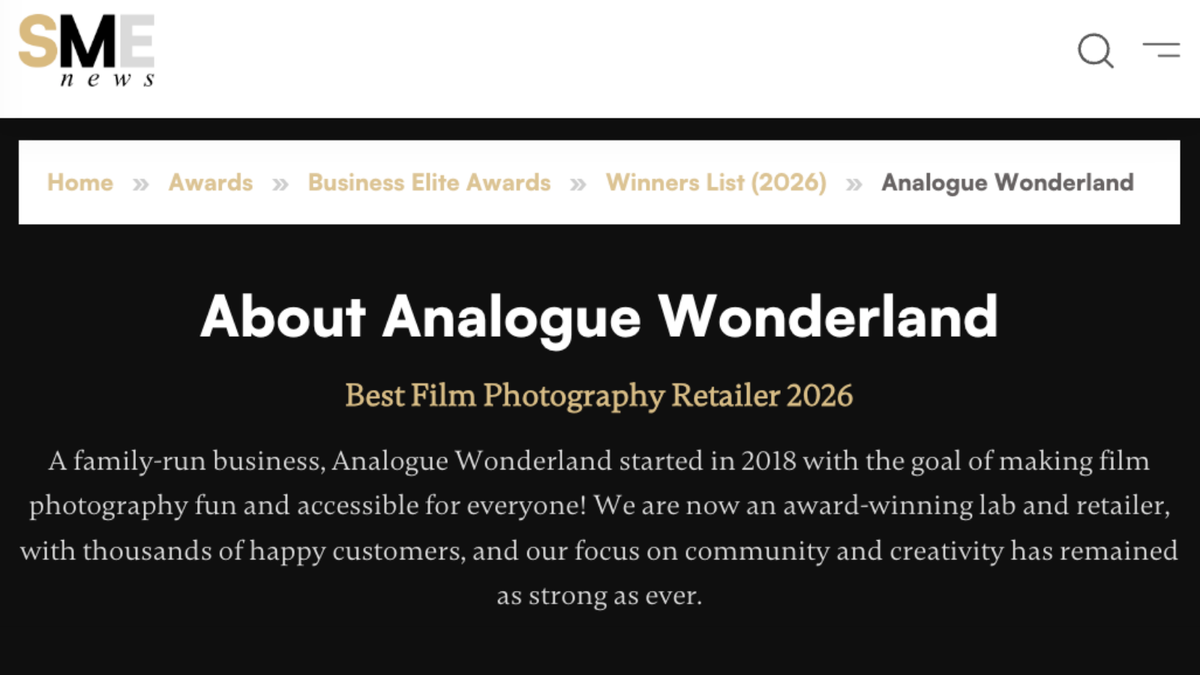
Analogue Wonderland is the Best Film Photography Retailer 2026!
We're thrilled to say that Analogue Wonderland has been recognised as the Best Film Photography Retailer in the UK for 2026 in the SME News' Business Elite Awards!
Double WonderPoints Weekend! 🤑 🤑
Welcome to a wonderful Double WonderPoints weekend.
This is an event where you get to earn TWICE as many WonderPoints as normal - 10 for every £1 spent on film, cameras, or developing your films 🌟 so you accelerate towards future savings much faster than normal!
- Opens in a new window.
2 Comments -
Janie • -
Janie •
It was an incredible day! So many folks popping by and learning about the process. Big Bertha was the star of the day- Al and Gregg were pretty popular too! Huge thanks to AW for your support and sponsorship!!
It was an incredible day! So many folks popping by and learning about the process. Big Bertha was the star of the day- Al and Gregg were pretty popular too! Huge thanks to AW for your support and sponsorship!!