


Shop the article


Harman Phoenix 125 Review: Bristol Streets and Autumn Leaves
Harman Phoenix 125 is one of the most talked-about colour films of the year, and it definitely splits opinion! Our Analogue Adventurer Masha usually sticks to 'regular' film stocks, so when Bristol served up two sunny autumn days in a row, she loaded two rolls of Phoenix 125 into her Canon A-1 and her Pentax 17 to make up her own mind. Let's see what she found...
Why I gave Phoenix 125 a go
If you have read some of my previous blogs, you know that most of the time I very much stick with similar 'regular' film stocks, and am not often drawn to their unusual counterparts, especially if they promise something vastly different to my go-to style. However, with so many conversations happening about Harman and their new Phoenix iteration, I couldn't resist giving it a go!
I'm a firm believer that you have to try something for yourself before making up your mind about whether you like it or not, and with it being very different from my usual choices, it's also a little fun!

Behind the scenes on the Bristol photo walk
The tech stuff
I am definitely not the person you should be asking about all the nitty-gritty tech stuff when it comes to film, but in short, Harman's new Phoenix iteration is re-engineered as an ISO 125 film, compared to its predecessor that was rated at ISO 200. For me, this is an indication that unless I am super lucky and autumn treated me with bright sunshine, I would probably be packing this film away until next summer.
That being said, we ended up incredibly lucky and the Bristol weather gods gave us not one but two sunny days in a row, meaning that I had the opportunity to shoot two rolls in vastly different environments.
Both rolls were developed and scanned by Analogue Wonderland (of course) in the WonderLab, whose technicians ensure accurate colour balance by emulsion (here's how we scan Phoenix), so please note that other labs may vary if they use images straight from the scanners!
Off the bat, I knew this film was non-conventional, but having never really shot with Harman stock (apart from B&W in the Lake District!), I wasn't really sure what to expect and where the final images would sit on my personal 'experimental film' chart. I think sometimes going into something with zero expectations is actually very helpful and can take off any unnecessary pressure too.
Just to paint you a picture of how few expectations I had and how blindly I went into this, once I got my scans back, I actually had to question whether what had come out was the intended look or not…happy to confirm that it was! Otherwise this blog would be titled 'What not to do with Phoenix 125' instead.
I do also have to give a very brief acknowledgement to the packaging here: it is fun, different and just generally cooler than the majority on the market.

Harman Phoenix 125 in all its packaging glory
Two rolls of Phoenix 125 (shot at box speed!) and two days of bright sunshine meant I could squeeze two vastly different activities into one weekend (what a luxury!) and also use two different cameras (not in a 'let's do a comparison' kind of way, but more in a 'why not, the cameras are sitting on the table all alone and sad, and we can't have one camera getting FOMO' kind of way).
My sunny Saturday activity ended up being a fun, small and very wholesome photo walk organised by a local community. For this I grabbed my Canon A-1, a regular in my rotation (simply because I wanted that extra little bit of control over focus and aperture).
Sunny Sunday on the other hand took me to a (relatively) local arboretum. For this outing, I wanted something a little simpler and more portable, something that could easily fit into my jacket pocket. And, of course, to no one's surprise, Pentax 17 came out victorious.
A walk through the Bristol streets
This was my first photo walk ever! So far, I've been very unlucky when it came to dates of other photo walks, meaning I simply couldn't join (*cough* AW photo walk *cough*), and what better way to test out a quirky roll of film than during a walk through the streets of Bristol on a perfectly sunny day, capturing a mix of everyday life, details and even some portraits!
It was also really nice to switch off, follow the group and focus on taking photos rather than worrying what to do or where to go (true bliss!). I knew that I wasn't looking for anything specific and instead came with the aim to wander and see what caught my eye.
This also ended up being my first proper time dipping my toes into street photography, which is now a firm favourite of mine, and I can't wait to do more. I think it really pushed me to pay attention to more ordinary everyday objects that, on a normal day, I would simply walk past without a second glance, and this led to one of my favourite shots of the roll! The combination of the unexpected subject, the layers of graffiti and the way film rendered the scene just makes for a really fun and unexpected shot!

Shot on Harman Phoenix 125 with a Canon A-1
I can definitely understand why this film is often described as Marmite…if you pick this up expecting to get 'regular' images at the end, you would be very disappointed! But in my opinion, I think it actually works perfectly for this kind of subject, and makes what is a very mundane and always overlooked electric utility box much more interesting, giving it a grungier (?) style (although I feel too old to know if this is even the correct term…in my eyes it is!).
To me, the very distinctive look of Phoenix 125 almost feels inverted (key word is almost!!!) with such contrasting turquoise and orange palettes coming through. I don't think anyone picks this film up for its accuracy, but I was still very surprised by how it interpreted the blues and browns. Funnily enough this film truly highlighted how dirty the harbour is, rendering it as orange and clay-like as the pavement in the second photo (ew but also that's pretty fun, no?).

Shot on Harman Phoenix 125 with a Canon A-1
It was also really fascinating how differently it interpreted shades of green. In the second photo alone, we have three different areas that are green in real life: the zip-up top of the volunteer model, the utility box she is leaning on, and the bushes behind her. But the film understood and rendered each of the greens in drastically different shades, especially when considering the top and the utility box were nearly identical shades of green seen by the human eye!
One of the perks of a photo walk that I had never considered is that you are surrounded by like-minded people that are also obsessed with photography, which meant that it was so much easier for me to sweet-talk them into standing in front of the camera for some portraits. This is very much a gap in what I feel comfortable shooting, and most of the time, persuading people to pose is a fairly hard task, so this was a win for me! What I found really interesting once I got the scans back, though, was just how different each portrait had turned out!


Shot on Harman Phoenix 125 with a Canon A-1
You can really tell what people mean when they say that Phoenix performs drastically differently depending on light and environment, and these differences are especially noticeable when looking at my impromptu models! I think it's actually quite interesting how much both the details and the colours changed depending on where the sun was in each photo.
In the first, the sun was behind me, shining directly at the subject; in the second, it was to our right, illuminating one side of her face; and in the last, the sun was actually behind her and the garage, with me squatting ever so slightly to avoid the rays shining directly into the lens. I love them all because they are so vastly different, but I think the last one is my favourite, simply because it feels much softer, with far less pronounced contrasts than the others. So, maybe indirect light is the way to go?
I actually ended up with one frame after the photo walk, which I saved for the arboretum the next day. This was never intended to be a comparison, but I couldn't help giving in to my curiosity. I wanted to see how an image shot on the Canon A-1 would compare to one shot on the Pentax 17, whilst keeping the subject the same (to at least slightly level the playing field in what was an already very unfair comparison).

Left image: Pentax 17, right image: Canon A-1
Whilst the Pentax 17 has a slightly wider lens compared to a 50mm Canon lens, I don't think this made a particularly drastic difference when you put the shots side by side. Instead, what caught my eye was how much more shadow detail the Canon retained compared to the Pentax, with much more detail coming through in the shadowy foliage on the right-hand side of the image.
Was that down to chance, my own user error or just simply two different cameras and rolls of film? I can only ever speculate, as this was the one and only shot taken on Phoenix 125 with the Canon A-1 in the arboretum.
Pentax 17 in the arboretum
With all the autumnal colours in full swing, one of my top priorities was to go to the arboretum as soon as there was a promise of sunny weather. And what a welcome change it was, swapping the busy Bristol streets for a much more picturesque, calm and less carbon dioxide-filled environment, with the crisp air, the smell of fallen, multi-coloured leaves and the promise of a hot chocolate.
And it wasn't just a change of scenery, but also of camera! Although the Canon A-1 came with me for reasons discussed above, the Pentax 17 was the lucky one to be loaded with the fresh roll of Phoenix 125. This camera has become very familiar over the past many months, and although it offers more limited control over aperture and focus, that simplicity is often a welcome change for me. Sometimes I just want to enjoy and relax in the moment, being much more spontaneous with my photographs (and what better way to do that than with a camera that fits so nicely in your pocket?!).

Phoenix 125 and the Pentax 17, ready for the arboretum
With so many trees full of colourful autumnal leaves, the arboretum is truly the place where the orange and red clay tones of the film shone the brightest, but it did sweep up the green tones under the same clay rug, rendering them almost dark brown. I think if you are planning to shoot somewhere with lots of greenery, this film might not be the best choice for you (unless, of course, that's the look you are going for!).

Shot on Harman Phoenix 125 with the Pentax 17
And although, as you can imagine, the colours in the developed images didn't accurately represent the foliage, the film still managed to preserve the different shades of the leaves (even in its own way), rather than rendering them all the same (hand on heart, this is something I was worried about, given my lack of prior experience with Phoenix). I think this really helped to bring out the different layers of the trees, helping to maintain the depth that was there in real life.

Shot on Harman Phoenix 125 with the Pentax 17
I used to think that this film being referred to as demanding perfect exposure and perfect light was an exaggeration, but I am happy to take that back now that I've experienced what it can deliver in perfect conditions! I don't think I can take any credit for how this photo turned out, and it definitely falls under the happy accident umbrella, but I think there is something truly mesmerising about this image that wouldn't have worked in quite the same way with 'regular' film.
The leaves almost seem to be on fire where the sunrays hit them, with those in the shadows still retaining their fiery orange tones and the slim branches running through the image looking almost like dark veins, adding another layer to the contrast.
Quite predictably, the half-frame format of the Pentax 17 definitely accentuated the grain of this film, making it feel much closer to what you'd expect from an ISO 400 film, at least in terms of how gritty they looked, which was particularly noticeable if there were large areas of blue skies in the shot.
That's not to say that the grain wasn't visible when shot on a full-frame camera (it definitely was!), but it felt much less 'in your face'. If I was to choose between shooting with Pentax 17 or shooting with Phoenix 125, I would pick both and simply load Phoenix 125 into a full-frame camera.

Shot on Harman Phoenix 125 with the Pentax 17
Do you often stumble across quaint cottages in arboretums? Well, we definitely do on a yearly basis, and it's actually a very fun way to compare how things around it have changed from one year to the next. Interestingly enough, whilst you can definitely tell that I struggled a little more to get the exposure right here, those struggles actually worked in my favour by hiding the annoyingly parked, bright white car on the side of the cottage, which was clearly visible to the human eye (maybe messed-up exposure isn't always a bad thing?).
I also think this makes the cottage stand out a little more, with the shadows and highlights emphasising its details. And of course, maybe a properly exposed image with all the details in the shadows well preserved would have been lovely too, but I am pretty chuffed with this one regardless! A little spooky too!

Shot on Harman Phoenix 125 with the Pentax 17
So, what are my thoughts and would I shoot again?
This film stock definitely does what it says on the metaphorical tin. It is quirky, it is very experimental and, in my opinion, fairly temperamental (and unforgiving if you don't expose it well) compared to other film stocks. But I also think this is exactly what makes it such an exciting creation! I think part of the fun with this film is the experimentation and never knowing what you'll get, and often I just told myself to stop guessing what could be and focus on just shooting!
It has an incredibly vivid and punchy, yet distinctive, colour palette (expecting it to render anything as it appears to the naked eye would be a mistake). It does have noticeable grain, however I think for me personally, it did not take away or distract from the subject. The grain did become more accentuated when shot with a half-frame camera, but that is something you have to keep in mind and be prepared for regardless of the film that you load into the Pentax 17.
Overall, I believe that like all film stocks, Phoenix 125 has its time and place, but it wouldn't be my first choice for trips or important life events. I think it's more suited to creative shoots or for those who always have a roll on the go and don't mind being a little less particular about the film's style or how it renders colours.
I do recommend that everyone tries it at least once (as it is indeed fun!) and makes up their own mind. Whilst you can read a blog about my experience, it's simply not the same as loading a fresh roll of Phoenix 125 into your go-to camera and giving it a go yourself! Plus, it is pretty cheap as far as film goes, and it's made right here in the UK, so support your (relatively) local makers!!!
Thank you Masha! This is such an honest look at a film that really does split opinion, and a great guide to where it shines (sunny streets and autumn leaves) and where it struggles (greenery and tricky exposures). And btw if you're shooting medium format, it comes in 120 too!
Ready to dive in?
Keep Reading
View all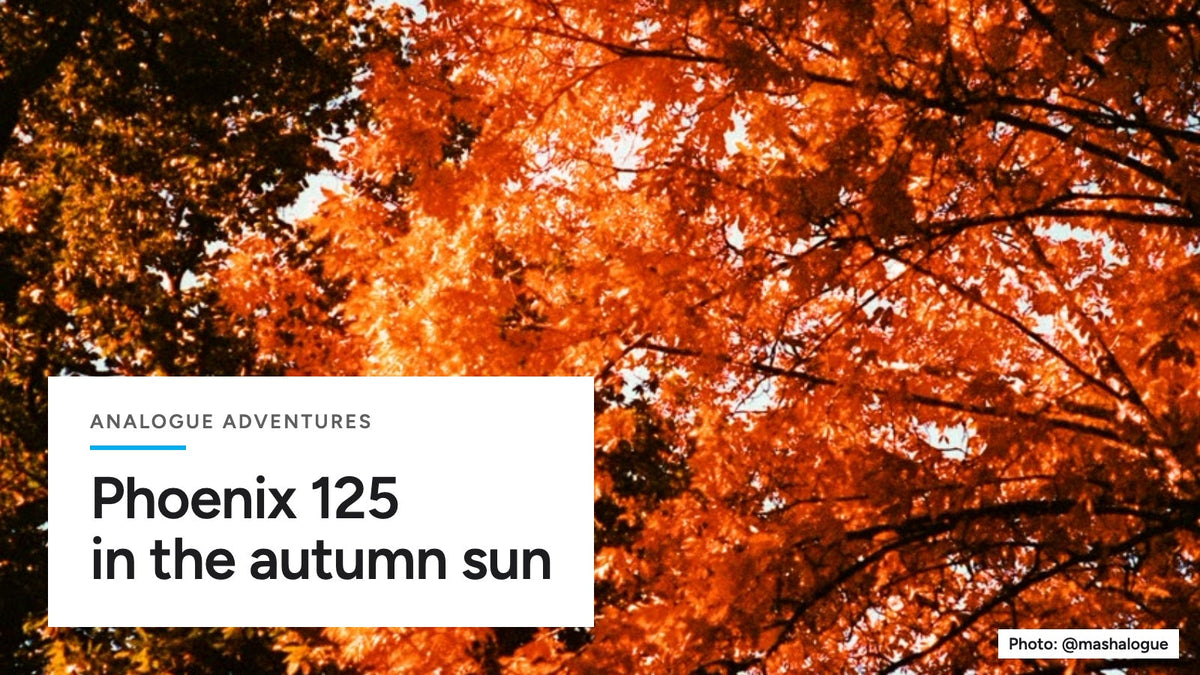
Harman Phoenix 125 Review: Bristol Streets and Autumn Leaves
Harman Phoenix 125 is one of the most talked-about colour films of the year, and it definitely splits opinion! Our Analogue Adventurer Masha took two rolls on a Bristol photo walk and round an autumn arboretum to make up her own mind.

Film Photography Christmas Gift Guide 2026: Gifts for Film Photographers
Not sure what to buy the film photographer in your life? Our 2026 guide picks the films, cameras and gifts our community loved most last Christmas, by person and by budget.
- Opens in a new window.