


Shop the article


Souping Film: Meredith's Recipes, Risks and Happy Accidents
Souping film means soaking a roll in a liquid (tea, lemon juice, bath bombs, even canal water) before or after you shoot it, so the soup eats into the emulsion and paints its own colours and textures over your photos. It is unpredictable, a little bit chaotic and completely addictive, and few people in our community do it with more enthusiasm than Meredith Rose 😅 Her souped rolls are developed in our WonderLab (just add the Souped Film add-on when you send yours in so we know!!) and we have been loving every set of scans. We asked Meredith how she got started, what goes into her favourite recipes, and how to soup safely without upsetting your camera or your lab. Over to Meredith...
How long have you been shooting film, and how did you get started in the hobby?

LomoChrome Turquoise souped in bubble bar, lemon juice and freshly boiled water.
My first film camera was a gift in my teens, and I used to love being in the darkroom doing my own development and printing. But I became disillusioned with photography after studying it at university and didn’t pick up a camera for years.
Now in my 30s, I was on holiday with my best friend Josh at the beginning of 2025 and found myself jealous of all the fun he was having with his old film camera, and decided to dig mine out as soon as I got back home.
The pause in shooting had given me time to reset and I was able to come back to photography as something to do just for the joy it brings, and I think that returning to the simplicity of analogue was a great way to rediscover that joy.
What’s your favourite camera to shoot with, and what kind of film do you use when you’re not souping?
I’ve always been a Canon girl, and I appreciate the ease with which I can use the lenses from my digital kit on my film cameras!
My everyday “throw in the bag” camera is a Canon EOS 300 with the nifty fifty (Canon EF 50mm f/1.8) attached. It’s a nice lightweight combination that still has the power and durability for what I inevitably put it through.
When I’m out for a serious “shooting day” I’ll also have my Canon EOS 30, generally with the EF 70-200 f/2.8L IS Mark III attached, but that combination is way too heavy for an everyday carry!
When I’m not souping I still tend to lean towards more creative films. I’m a big fan of colour changing films like LomoChrome Purple/Turquoise and Harman Switch Azure. I also love pre-exposed films like Revolog and Psych Blues.
And if it isn’t creative film, it’s likely to be a high ISO because I appreciate the flexibility and love low light shooting.
What made you start souping film? Did someone in particular inspire you, or did it simply arise as part of your analogue journey?

Kodak Gold 200 souped in Twinings “Defence” tea, lemon juice and freshly boiled water.
I discovered souping via Hanalogital’s pre-souped films, while browsing the Analogue Wonderland website obsessively, and thought “huh that’s weird - I need to try it!!” I think I was hooked from shooting the first one, but particularly when I got my first scans from her “CHAROITE” film back in October 2025.
I loved, and still love, that souping allows you to photograph otherwise mundane scenes and turn them completely otherworldly. The best soups are ones which obscure and interact with parts of the subject. It’s difficult to control or predict the final results but that makes the successes all the more rewarding.
I shot a lot of Hanalogital pre-souped films and was so nervous to try souping my own. But I couldn’t resist the allure of creating something wild and magical through my own experiments, so souped my first roll myself in early 2026.
Talk us through your first souping recipe: did it go well?

Kodak UltraMax 400 souped in isopropyl alcohol and freshly boiled water.
It didn’t go badly… but it was disappointing.
It was a throwaway roll, just random shots of my houseplants, but I was still terrified of over-souping it and ruining the roll. It was a mix of warm water, Fairy Liquid and lemon juice for just a few hours, and while there were some visible results I was very underwhelmed.
But this taught me what is probably the most important lesson I’ve learned from souping: don’t be afraid to fail.
A few weeks later I shot six rolls of film on a walk along the canal and souped them all in different recipes. The results were mixed but the best results came from the most damaging recipes (one isopropyl alcohol/lemon juice mix, and one washing machine tablet mix). There were a lot of lost and heavily damaged frames but what survived I loved!
What are the biggest photographic challenges with souping film?
Ignoring the problem of costs associated with shooting any analogue, and the complications with developing souped film…
Probably the unpredictability of the results. It’s difficult to plan clever compositions when you don’t know what will survive or what effects the soup will have on the final results. It’s absolutely part of the fun, but can be very frustrating when a shot you’re particularly excited about is destroyed or doesn’t turn out the way you were hoping it would.
And a challenge that’s probably only applicable to me… I get too excited about souping and soup films that I really shouldn’t. The number of rolls of photos of my goddaughter I’ve ruined is way too high!
How do you overcome the challenges?

LomoChrome Turquoise souped in a bubble bar, lemon juice and freshly boiled water.
Be brave, don’t be afraid to fail; recognise that you will fail, but that’s alright and is how it should be. It’s how we learn.
But you can also take steps to mitigate failure! It’s controversial with film photography, but I never take just one shot of a subject, particularly if it’s a composition or view I’m particularly keen on. I still approach it in a much more considered and measured way than you can with digital photography, but am less precious with the film and with conserving shots than some people may be.
When I’m out specifically to shoot film I’ll always have two cameras on me and will often shoot the same thing on each, but they’ll be souped separately and in different recipes. This allows for variety of composition with different lenses but also makes it more likely that at least one shot of the subject will survive.
And keep a detailed record (I use a big spreadsheet) tracking your film stock, recipe, time and results for each soup. This way you can avoid repeating what doesn’t work and focus on what does!
What is your current favourite soup recipe?

Kodak UltraMax 400 souped in whipped soap, gin, lemon juice and freshly boiled water.
I tend to categorise my soups as either “natural” or “unnatural”. Natural soups will be made up of things like teas, foliage, waste food etc, and tend to produce much more organic shapes and harmonious results. My unnatural soups are often alcohol or soap based (I’m a sucker for soups made from bath bombs in particular) and tend to produce much harsher results as the emulsion on the film can be much more degraded.
Almost all my soups have a good squeeze of lemon juice in them, and are made with boiling water. The heat is an important catalyst which speeds up the reaction and means I tend to soup for four to six hours rather than days at a time.
Twinings do a “Defence” green tea blend which produces reliably fun and colourful results. For someone looking for a recipe for their first soup I’d recommend two of those tea bags, a quarter cup of lemon juice and 2 cups just-boiled water. Soup for four to six hours (the longer you leave it the more intense the results), stirring regularly (or whenever you remember)!
When your soup is finished, rinse the cassette thoroughly in cold water. I like to leave my rolls to sit in cold water for a while, changing the water every few hours until it becomes clear.
I will say that an important and often overlooked part of the recipe is the film which you’re using. I tend to use Kodak UltraMax 400, because it’s cheap and reliable, but every film has different chemistry; UltraMax 400 and Kodak Gold 200 will react very differently to being souped in the same liquid despite coming from the same producer.
My favourite film to soup is Lomography Turquoise because the results you can get with that are absolutely magical and I love the colours!
People worry about damaging things with souped film (their camera, their clothes, their lab’s machines). How do you manage that risk?
When I first started souping my primary concern was damage to my camera. It doesn’t make a difference if you soup before or after exposure, so I have always souped my film after exposure to avoid leaving any debris from the soup in the back of the camera.
That said, I have recently started souping a few rolls before exposure. These (after rinsing as described above) I’ve shot in my Reto Pano point-and-shoot (just in case!) but haven’t had any issues with debris yet.
Personal safety (which probably should have been my primary concern!) mostly comes down to common sense. I wear an apron, and always use protective equipment (latex gloves and safety glasses) when souping with something I wouldn’t want to get into my eyes or any open cuts (looking at you lemon juice, OUCH!). It’s always a good idea to soup in a well ventilated area, and if you’re trying a recipe which uses cleaning products you must double check your chemistry to make sure you don’t accidentally create anything else nasty… Never mix bleach-based cleaning products with acids like lemon juice, as this can release chlorine gas.
Never ever ever send souped film off to a lab to be developed without telling them. You’ll contaminate their chemicals and not only will you really annoy your lab, you’ll probably ruin someone else’s precious photos.
Send your lab a note with the souped film to let them know what you’ve used to soup it too, just in case they want to take some added precautions while processing it by hand.
If you aren’t sure if your lab will develop souped film (a lot won’t) then contact them to ask first. Most labs who do develop souped film need to do so by hand so charge a small additional fee.
If you do your own development at home you won’t be able to reuse the chemicals after developing souped film, so develop your souped film last!
What are your favourite souped photos ever, and why?

Kodak UltraMax 400 souped in Twinings “Defence” tea, lemon juice and freshly boiled water.
Oh god, tricky question! Can I pick favourite rolls, rather than individual photos?
I’ll always have a soft spot for my first roll of souped LomoChrome Turquoise. It was shot in the Highlands, a place very special to me, and I feel the results of the soup captured the magic I feel up there perfectly.
I have a roll shot on a beach that developed as if overexposed, with the most incredible rainbow colours. It also looks like a double exposure with some curtains, but that’s just the soup doing unexpected things! I normally lean towards blue based palettes but I really love the results from that soup. Again, it’s some Highland magic.
What is your most unexpected souped photo, and why?

LomoChrome Turquoise souped in Twinings “Defence” tea, lemon juice and freshly boiled water.
Recently I had a roll of souped LomoChrome Turquoise come back that really surprised me. Normally I’ve souped it in bath bomb and lemon juice mixtures, which create beautiful colour shifts in waves but leave the image underneath visible. This time I’d souped a roll in a much milder herbal tea mix (the “Defence” blend mentioned above!) and there was very little of the landscape left visible. They were beautiful, but not at all what I’d expected!
What is next in your experimental photography plans?
Over the summer I started experimenting with soups using things taken from the location I was photographing: loch or sea water, animal droppings, plant material etc.
I really love the idea that this gives the subject of the photo (which, for me, tends to be landscapes) some input on the final image. Because the final result of a soup is so unpredictable it really makes the process feel like a collaboration.
I’d like to continue exploring this over the next few months. I also want to further experiment with souping more varieties of film; pre-exposed and possibly even pre-souped are next on my list to try!
And I want to put together a collection of photos where the soup was so strong that the subject is gone, leaving just something abstract which I think is quite beautiful.
What would you say to anyone who is curious about souping film?

Harman Switch Azure souped in a bubble bar, lemon juice and freshly boiled water.
Don’t be afraid of failing. It will happen, and hopefully you’ll be able to see the beauty in images where your original image isn’t visible. My biggest failures are the ones where I was too scared and ended up with mild soup results, not the ones where the emulsion melted off.
Keep a good log of your souping method, and if you send multiple soups to be developed at once, speak with your lab in advance to come up with a simple system for identifying which is which. For me I label them 1, 2, 3, 4 etc with tape and Analogue Wonderland include the number in the folder name when they upload the scans.
But absolutely give souping a go!! I’ve found it an incredibly rewarding and addictive experience, and the online souping community is fantastic.
Where can people go to see more of your photography?

Kodak UltraMax 400 souped in canal water and pickles.
You can find me on Instagram, @meredith.r0se! Feel free to send me a DM, I always love talking to people about souping and seeing other people’s results.
Thank you so much, Meredith! This is one of the most generous guides to souping film we’ve read: a first recipe anyone can try at home, honest lessons from the rolls that didn’t work, and the safety and lab advice every souper needs. If it has you reaching for the teabags, pick up a roll of Kodak UltraMax 400, get souping, and send it to the WonderLab with the Souped Film add-on when it’s done. We can’t wait to see what you make!
Ready to dive in?
Keep Reading
View all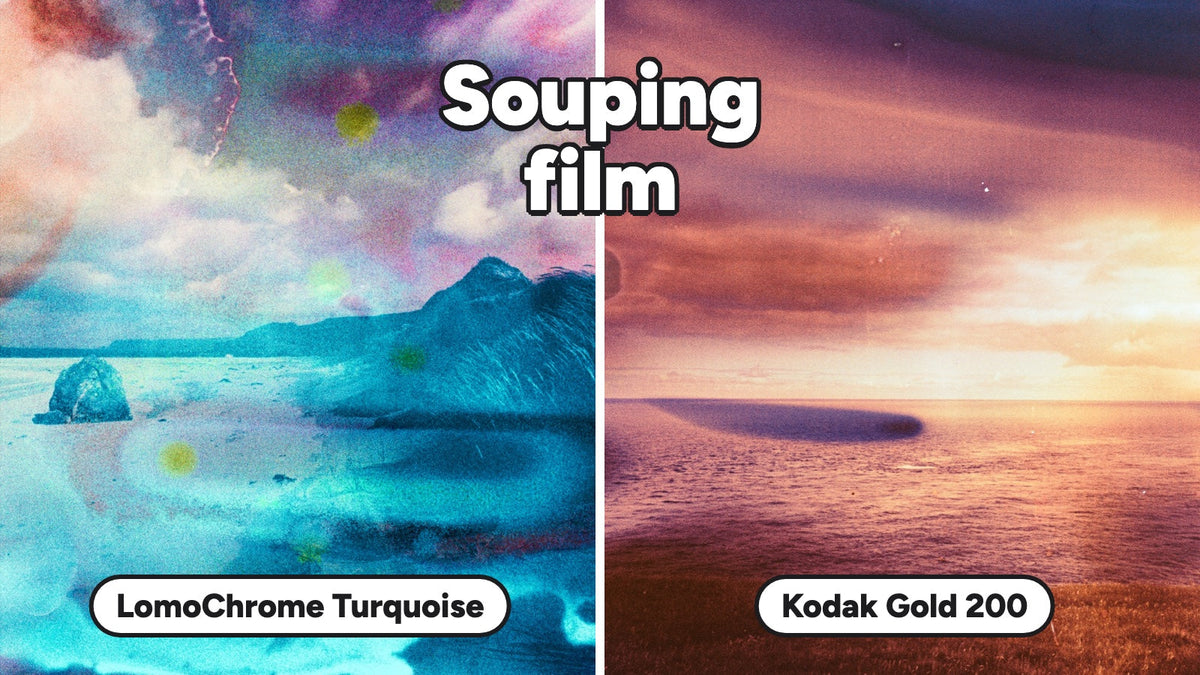
Souping Film: Meredith's Recipes, Risks and Happy Accidents
Souping film means soaking a roll in tea, lemon juice, bath bombs or even canal water so the soup paints its own colours over your photos. Community photographer Meredith Rose shares her first recipe, her favourite soups, and how to soup safely without upsetting your camera or your lab.

CineStill 800T at Night: The Bright Lights of Luxembourg's Funfair
Shooting film at night can feel like a leap of faith, which is exactly what CineStill 800T was made for. Our Analogue Adventurer Masha had been saving a roll in her fridge for the perfect moment, and Luxembourg's enormous Schueberfouer funfair turned out to be it! She also slipped in a few frames of Kodak 800 for a fun comparison. Let's see how she got on after dark...

- Opens in a new window.